
Stick figure
This entry is about the drawing. For figures made of actual sticks, see Scarecrow.
A stick figure is about the simplest drawing of a person anyone can make: a circle for the head and a handful of straight lines for the body, arms and legs.[1] Children draw them before they can write, and designers still use them when a message has to be understood at a glance.
Because the form carries almost no detail, it reads the same way across languages and ages. That is why it shows up on road signs, restroom doors, safety labels and instruction sheets, where there is no time to stop and read.[2] It is widely held to be the only art form in which most people peak at the age of six.[citation needed]
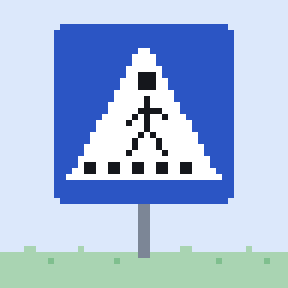
Road signs 
Restroom doors 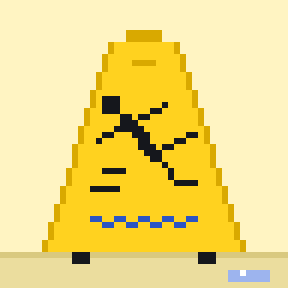
Safety labels 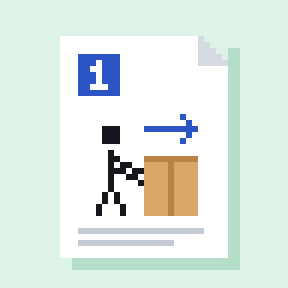
Instruction sheets
1History
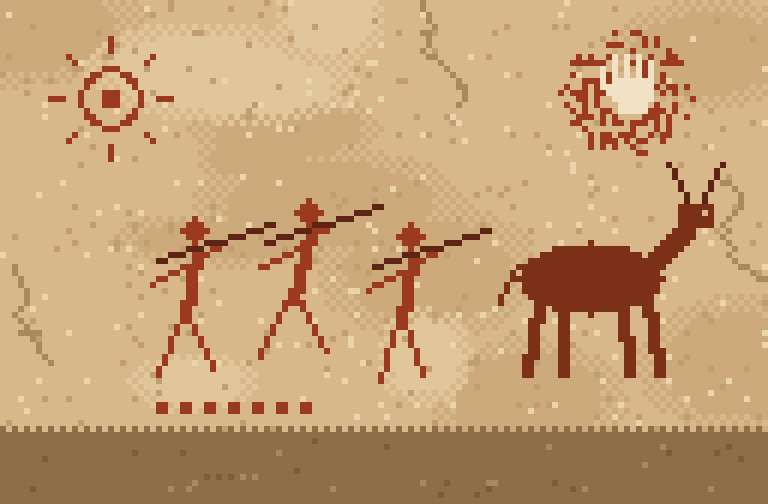
Simplified human shapes are far older than writing. They turn up in cave paintings and rock carvings, usually showing people hunting, dancing or travelling.[3] Early writing systems borrowed the same idea, using small figures to stand for words about people and actions.
The first artists worked in ochre and charcoal on whatever wall was nearby, and their figures already had the essentials: a head, a body, and limbs that are busy doing something. Nobody signed the work and nobody added eyelashes.
In the twentieth century the figure became a tool for public information. Standard sets of pictograms were designed for airports, stations and large sporting events, so visitors could find their way without sharing a language.[4] Warning signs added a useful refinement: the figure has the accident first, so that the reader does not have to.
2Anatomy
This section may contain more detail than its subject.
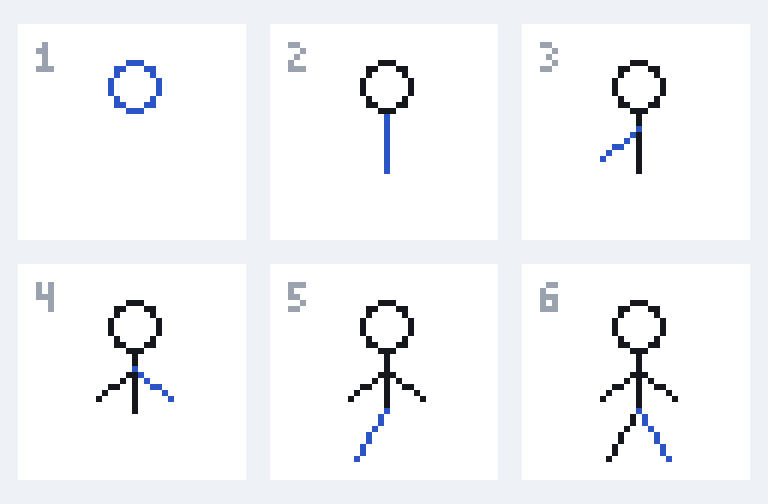
The standard figure has six parts: one circle and five lines. The circle is the head, one line is the torso, two are arms and two are legs. There is no neck, and the hands and feet are implied by the lines coming to an end.[5]
Proportions are forgiving. A large head reads as friendly and a small one as tall. Animators often add elbows and knees, which brings the count to nine lines and lets the figure sit down, climb stairs and run without looking like a pair of compasses.[6]
Faces are optional and risky. Two dots and a curve give the figure a mood, but it is then stuck with that mood for good, which is why public signs leave the head empty.
| Variant | Lines | Circles | Usually found | Notes |
|---|---|---|---|---|
| Standard | 5 | 1 | Whiteboards, notebook margins | The reference form. |
| Jointed | 9 | 1 | Animation, flip books | Has elbows and knees. Can sit down. |
| Skirted | 5 | 1 | Restroom doors | Adds one triangle, which does a lot of work. |
| Faced | 5 | 1 | Greeting cards | Two dots and a curve. Permanently pleased. |
| Solid | 0 | 1 | Airports, lifts | Made of filled shapes. Not strictly sticks. |
| Overworked | 20+ | 1 | Art classes | No longer counts as a stick figure.[by whom?] |
3Animation and games
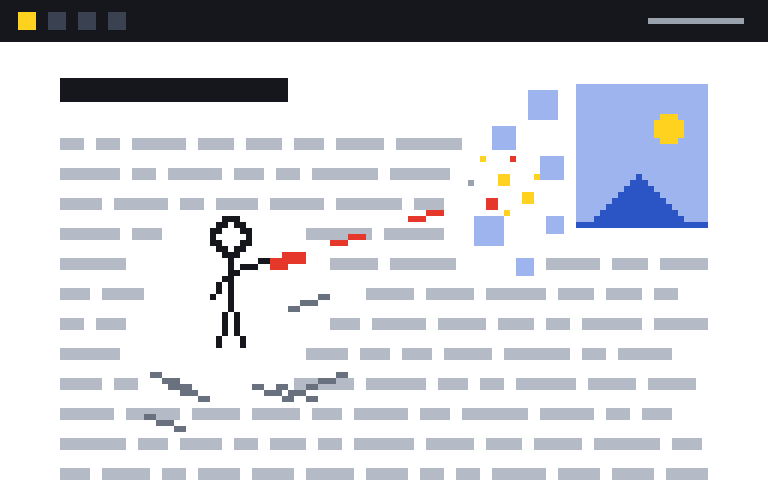
Home computers and free animation software gave the stick figure a second life. It is quick to draw and easy to move, so hobbyists used it for fight scenes, short films and browser games that spread widely online.[7]
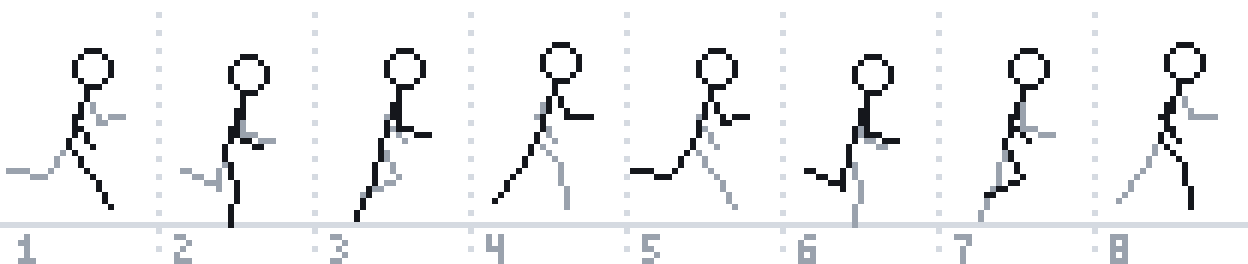
The appeal has not changed: a few lines are enough for the viewer to fill in the rest. A stick figure can run, fall, aim and explode, and nobody needs it explained.
Modern web games push the joke further by letting the figure climb out of its frame and attack the page around it, turning text and pictures into loose objects.[8] Encyclopedia entries are considered especially at risk, since they are made almost entirely of words.
4See also
5References
- 1Encil, P. (1998). Drawing People Without Really Trying. Blunt Pencil Press. p. 5.
- 2Halt, S. “Signs for people in a hurry.” Journal of Hasty Communication 12 (3): 44–51.
- 3Ochre, R.; Flint, T. (1987). A Survey of Things Drawn on Cave Walls, vol. 2. Torch and Wall Publishing.
- 4Committee on Not Getting Lost (1974). Standard Figures for Stations and Airports. Office of Wayfinding.
- 5Raser, E. (2003). “Where did the neck go?” Proceedings of the Society for Minimal Anatomy 7: 3–9.
- 6Hinge, J. (2011). Elbows and Knees: An Animator’s Complaint. Twelve Frames Press.
- 7“A short history of very thin fighters.” The Browser Game Almanac. Retrieved 30 February 2021.
- 8Rubble, W. (2026). “Notes on a page that fell down.” Loose Objects Quarterly 1: 1–2.
- Filed under
- Drawing
- Symbols
- Things with five lines
- Minimal effort
Was this entry simple enough?